Discovery Engine
Music (and media) discovery used to be social. Someone played a record, you heard something you'd never have found on your own, and your taste shifted. Algorithms replaced that with optimization loops that reinforce what you already like. SignalShare(Patent Pending) brings the social element back, not by sharing playlists or exposing libraries, but by letting users publish and subscribe to taste itself.
The Opportunity
Recommendation algorithms are optimized for engagement, not exploration. The result: filter bubbles, narrowing taste, and a listening experience that feels like confirmation rather than discovery.
Every social feature on streaming platforms tries to fix this by exposing data. Spotify Blend shows both users' listening. Apple Music Friends Mix surfaces friend activity. Last.fm ties compatibility to visible scrobble histories. If you want to benefit from someone's taste, you both have to open your libraries.
On top of that, users have no meaningful control over what shapes their recommendations. You can thumbs-up a track, but you can't say "I want my recommendations influenced by this person's sensibility" or "stop being influenced by that signal." The algorithm is a black box.
SignalShare(Patent Pending) addresses both gaps: making discovery social again at the algorithmic level, and giving users direct control over what influences their recommendations, how much, and for how long.
My Role
Solo founder. Concept development, competitive analysis, prior art research, technical architecture, patent strategy, and building a validated proof of concept.
A deliberate part of this project was choosing the right AI tool for each job. Collaborative filtering (ALS via LensKit) powers the recommendation engine because the problem is mathematical: learning latent factor representations from interaction data and performing vector arithmetic on them. An LLM would be the wrong tool. Claude with extended thinking handled prior art research and patent drafting, the kind of deep analysis and synthesis across 35+ sources where LLM reasoning outperforms manual search. Cursor (agentic coding) handled implementation: I designed the architecture and data model; the agent built it with me reviewing and course-correcting at each step.
— Josh Antonuccio, Director, School of Media Arts and Studies, Ohio University
Process
Mapping the gap: Analyzed social features across Spotify, Apple Music, Last.fm, Pandora, and 10+ platforms. Every one operates at the content level (playlists, tracks, libraries). None operate at the embedding level, the learned representation that actually drives recommendations. Content-level sharing exposes raw data by definition. Embedding-level operations can transfer taste while preserving privacy.
Prior art analysis (35+ sources): The landscape is crowded at the component level but empty at the system level. DiffNet and TrustSVD modify embeddings based on social connections, but during training, not as a user action. Profile injection attacks achieve the same outcome (influencing another's recommendations) but adversarially. ELM (ICLR 2024) demonstrates the exact interpolation formula on user embeddings, but for research, not as a feature. No patent, paper, or product combines user-initiated, asymmetric, private, reversible, post-hoc embedding blending. The novelty is the combination.
Concept refinement: The core idea was always a marketplace of taste influences: users sharing what they like without exposing their libraries, and subscribers choosing what shapes their recommendations. What the patent drafting and POC process refined were the mechanics. Influence budgets and weight sizing were formalized to ensure the subscriber's taste always stays dominant. Reversibility, always a design goal, was validated as technically clean at the vector level. The publish/subscribe model, searchable signal registry, and consent framework gave the original intuition a precise, defensible structure.
Architecture: ALS was chosen specifically because it produces dense embedding vectors that support meaningful interpolation. Supabase (Postgres + Edge Functions) handles the backend. The subscriber's original vector is always stored for clean reversion. Multi-subscription uses influence budgets so organic taste always stays dominant.
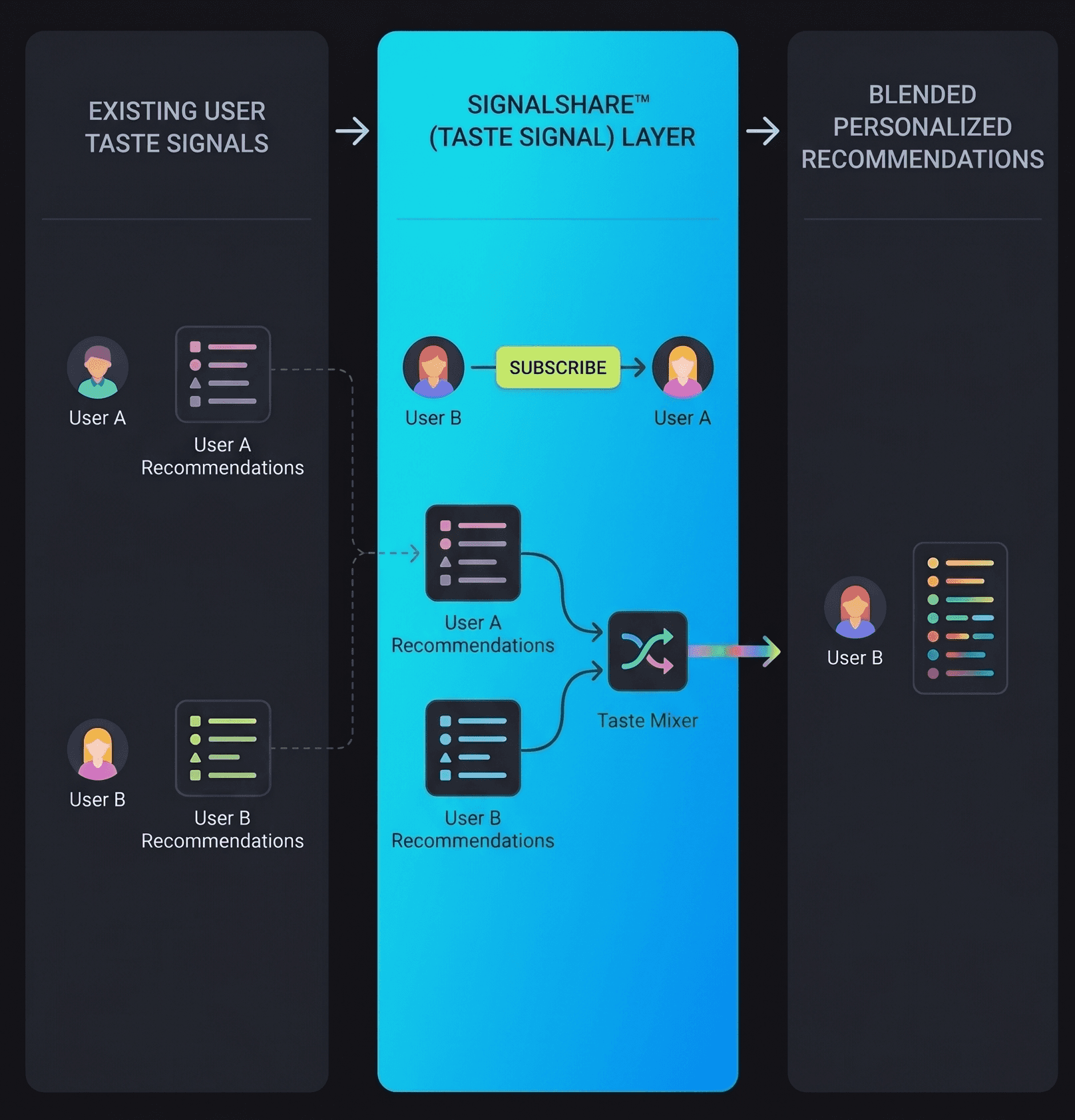
High Level Architecture
Solution
SignalShare(Patent Pending) gives users two things no platform offers: a way to bring outside taste into their recommendations intentionally, and full control over how much influence each source has.
Capability | Spotify Blend | Apple Music Friends Mix | SignalShare* |
|---|---|---|---|
Discovery mechanism | Shared playlist (content) | Activity feed (content) | Embedding blend (algorithmic) |
User controls influence | No | No | Yes (levels + budget) |
Privacy preserving | No (shared playlist) | No (visible history) | Yes (latent space) |
Fully reversible | Partial (leave blend) | No | Yes (stored original vector) |
Open discovery | No (invite only) | No (friends only) | Yes (searchable marketplace/board) |
Users subscribe to taste signals that reshape their algorithmic recommendations. They choose influence levels, stack multiple signals, and unsubscribe to fully revert. The blending happens in latent vector space, so taste transfers without data transferring.
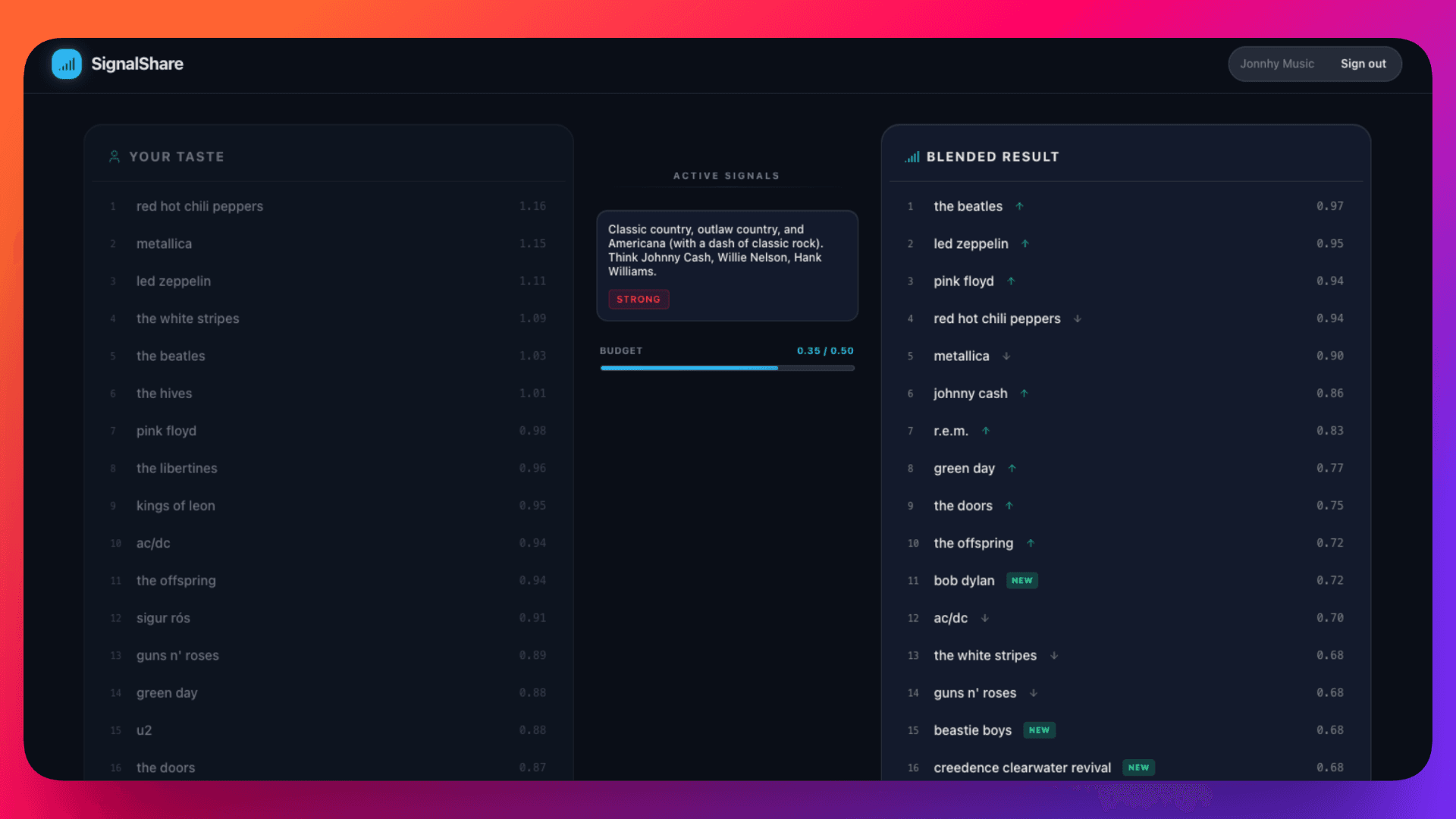
Active taste signals with influence budget -> blended recommendations.
Imapct
SignalShare(Patent Pending) is an early-stage personal project with a validated proof of concept and a defined IP strategy. The mechanic works. The white space is confirmed. What comes next is filing and exploring integration paths.
The POC confirms that applying a taste signal produces meaningful, predictable recommendation shifts. Reversion restores the original set exactly. Analysis of 13 patents, 40+ academic papers, and 10+ commercial products confirmed SignalShare(Patent Pending) occupies genuine white space. US provisional patent application drafted with broad independent claims.
Milestone | Status |
|---|---|
Prior art analysis (35+ sources) | Complete |
POC build and validation | Complete |
Demo UI | Complete |
Patent specification draft | Complete |
US provisional filing | Complete |
Reflection
Discovery is a product problem, not an algorithm problem. Better discovery doesn't require better algorithms. The CF model in the POC is standard technology. What's missing from every platform is the layer that lets users steer what influences their recommendations. The innovation is a new verb ("subscribe to someone's taste"), not a new algorithm.
Right tool for each job. This project used three types of AI for three different reasons. Classical ML because the problem is mathematical. LLM with deep reasoning because synthesizing 35+ sources into defensibility assessments requires structured analysis. Agentic coding because implementation speed matters when validating a concept, but only when a human designs the system being built.
Patent drafting as product strategy. The most valuable insight came from writing the patent. Articulating claims against prior art forced the reframing from covert influence to consensual marketplace, making the product more compelling, more ethical, and more defensible at the same time.
— Seth Yudof, Entertainment Entrepreneur | Rolling Stone